WHAT DISCOVERY ACTUALLY READS
Named sources, not a category list.
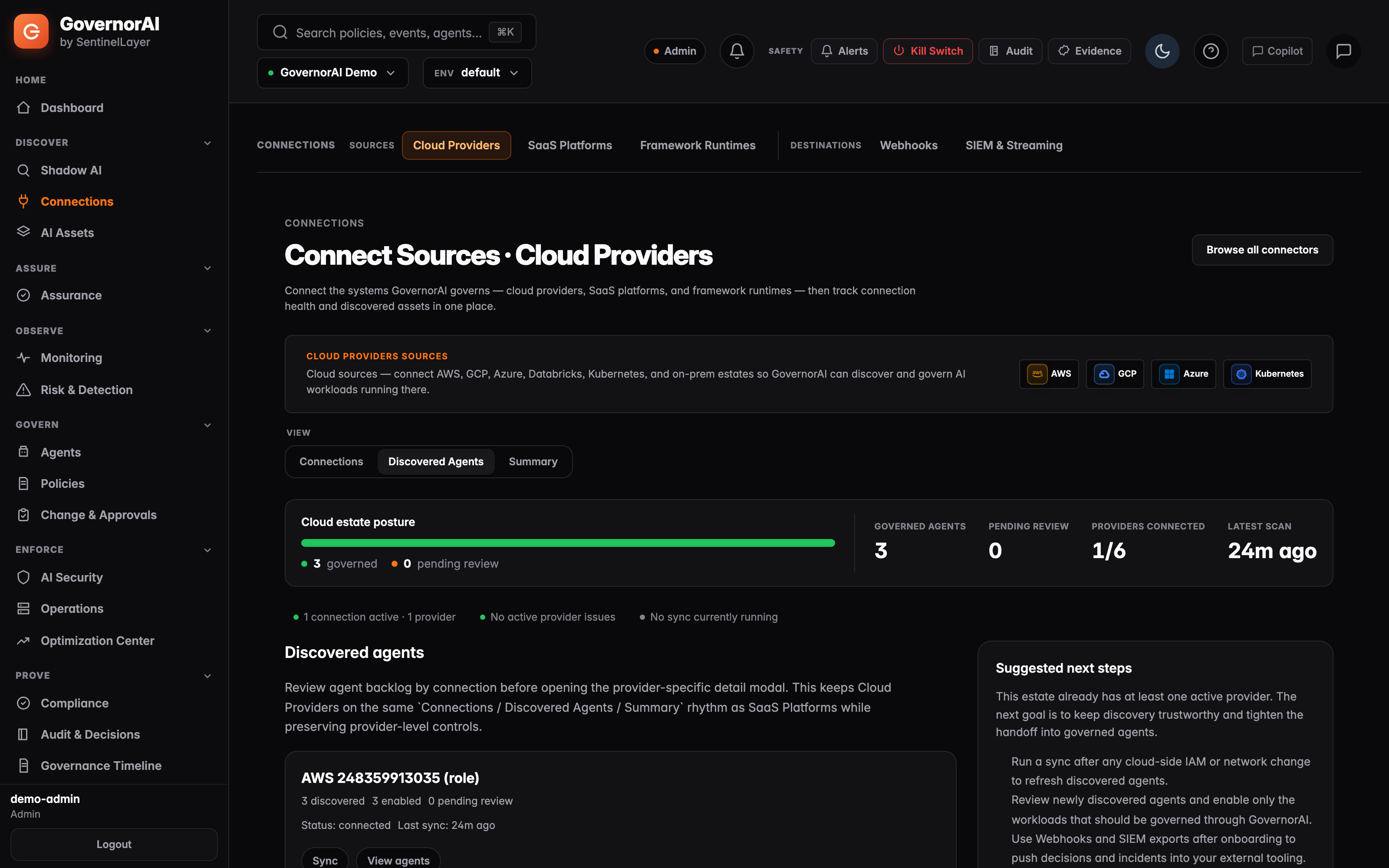
Every source is a shipped adapter with a real parsing contract, and every source carries a posture: connected when an enabled feed exists, available when the adapter is registered and you have not wired it yet, planned when nothing ships. The surface is derived from live wiring, so it cannot claim a source the backend cannot actually ingest.
Stated precisely Read-only discovery from supported sources. Coverage is exactly the set of sources you connect — nothing is inferred about the ones you do not. Each source resolves to connected, available or planned from live wiring rather than a marketing list, and each connected feed reports healthy, stale or not configured: a feed that is enabled but has never reported is stale, because silence is not health. A coverage grid states, per source family and per contribution, whether you have a live source, a shipped source you have not connected, or a genuine gap.
Honesty note — what discovery does not do Discovery is not a network product. There is no tap, no proxy and no packet inspection anywhere in it: every source is a log, an audit record or a control-plane list call that a system you already run hands over. The blind spots of those systems are therefore our blind spots too — an agent calling a model over a path that no connected source records is invisible to GovernorAI, and connecting no sources discovers nothing.
Inside a connected SaaS tenant, deciding which automations count as AI is partly a keyword judgement over names and descriptions, tuned to be broad so an operator can dismiss what does not belong rather than never see it; the n8n connector deliberately lists every workflow. The risk level attached to a discovered SaaS agent is inferred from what that platform's objects typically reach, not measured from that tenant's grants — Slack is the one connector that reads the app's real OAuth scopes. Only Salesforce and ServiceNow support a single connection that carries both discovery and governed execution; the rest are discovery-only.
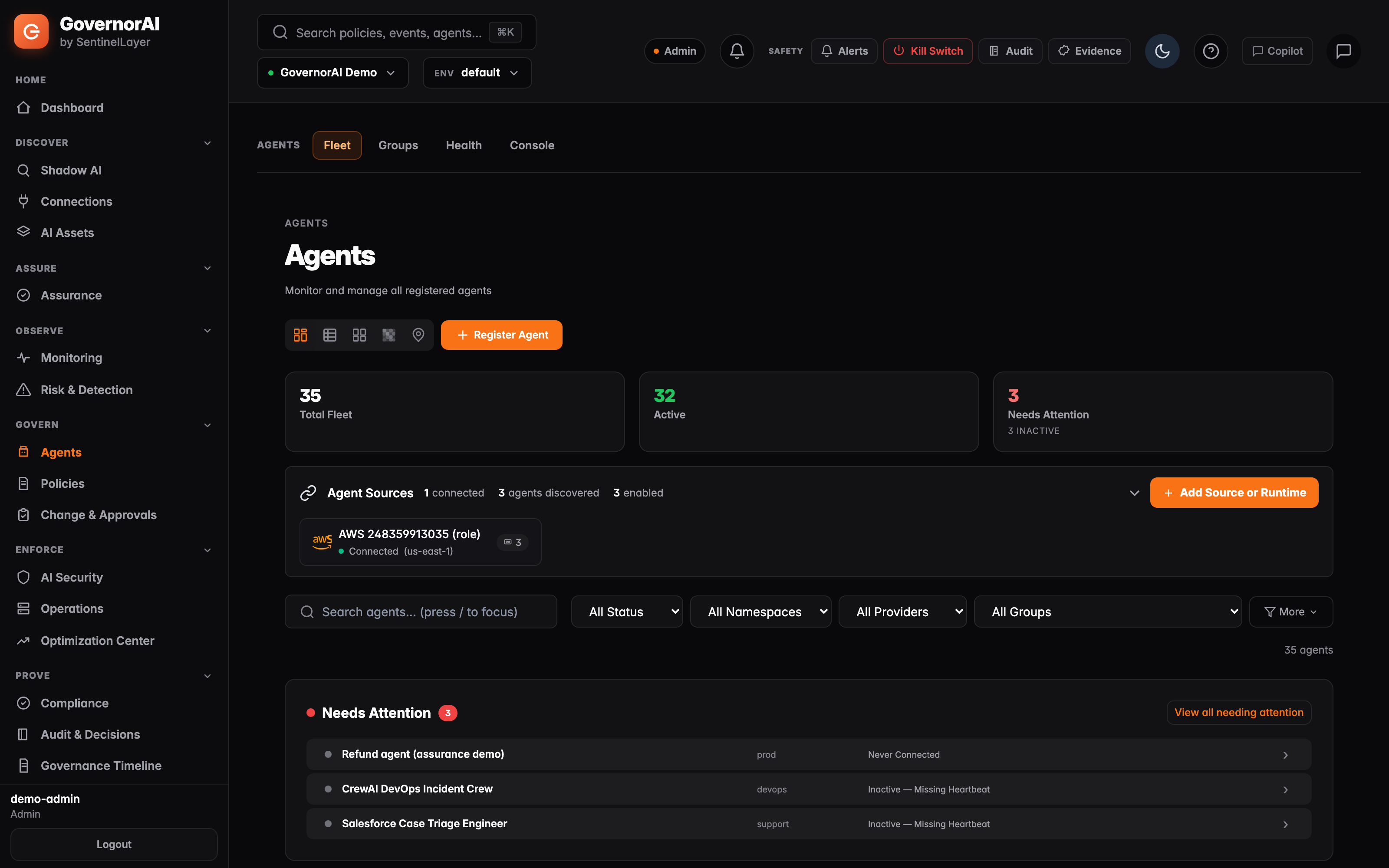
Framework runtimes are registered by an operator or by the runtime itself; nothing scans your repositories or your hosts to find them. The MCP catalog is a registry of publicly published MCP servers — it never connects to an MCP server, and its behavioural dimension is not assessed yet, so it tells you what a server is, not which servers are running inside your estate. And a finding is a starting point for triage: the discovery path itself never blocks, disables or reconfigures anything. Holding a discovered subject is a separate action on a separate permission, taken deliberately, and the state machine refuses it outright on a finding that rests only on rhythm.