GovernorAI evaluates
OPA runs as a Go library inside the decision path. Policies are managed here, or loaded from the filesystem. Nothing external to operate.
- mode
- embedded
- source
- managed · filesystem
- operated by
- GovernorAI
Platform / Policy & Governance
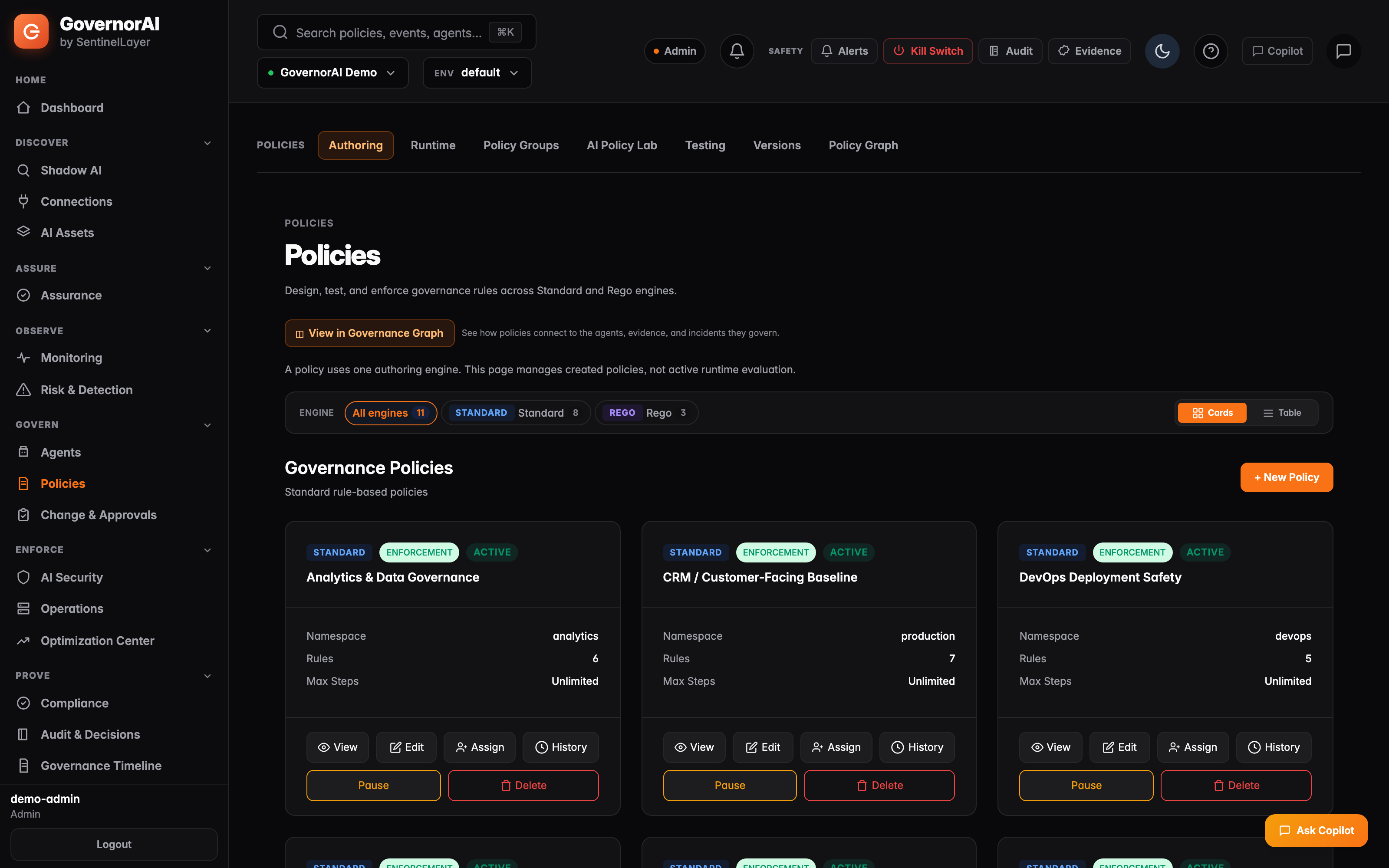
Three engines ship in the box — native rules, CEL expressions and Rego. If your organisation has standardised on OPA, point GovernorAI at your existing server: your policies, your language, your review process. You write no policy here.
loading…SEPARATION OF CONCERNS
OPA is CNCF-graduated and already deployed across many enterprises for Kubernetes admission control. Where that is true, the platform team has an engine, a Rego codebase, a review process and an owner — and no appetite for a second policy system. Configuration is per tenant, so both modes can coexist across an organisation.
OPA runs as a Go library inside the decision path. Policies are managed here, or loaded from the filesystem. Nothing external to operate.
GovernorAI calls your OPA server for the verdict. Your policies stay in your repository, under your review process, owned by your team. GovernorAI contributes the agent action seam and the evidence.
The usual objection to a governance platform is that it asks a team to move its policy into a new system, learn a new language, and re-run an approval process that already works. In remote mode none of that happens. The policy engine, the language and the separation of duties stay where they are; what GovernorAI adds is the point of enforcement and the record.
Remote OPA is a deployment configuration, not a default — a tenant-supplied server address is treated as untrusted and cannot be pointed at loopback, private or cluster-internal addresses; only an operator-configured address may reach a sidecar. Policy semantics can differ between engines, and where a policy is transpiled the divergence is reported rather than silently resolved.
BEFORE YOU ENFORCE
Every policy carries a governance mode. The same rule can observe traffic, run alongside the real decision, or take the decision — so a team can prove a policy behaves correctly against production traffic before it is allowed to block anything.
audit_only The policy evaluates and records. It never changes an outcome. Use it to learn what a rule would have caught.
shadow The policy runs against live traffic in parallel with the decision in force, so its verdicts can be compared before promotion.
enforcement The policy's verdict is the outcome at the seam. fail_closed governs what happens when it cannot resolve.
The read-only entry point is not just discovery. A policy can be written, tested against recorded traffic, and run in shadow against production before anyone grants it the authority to deny. Enforcement becomes a decision made with evidence, rather than a leap.
POLICY LIFECYCLE
Numbered because the order is load-bearing: a policy cannot be promoted past a stage it has not cleared.
Write in native rules, CEL or Rego — or bring policy in from your own repository. Templates and natural-language drafting assist; neither is required.
templates · NL draftingRun a policy against fixtures and recorded traffic. Similarity checks surface rules that overlap or contradict; dead-policy detection finds rules nothing reaches.
testing · similarity · dead policyProject the effect before it lands: what a change would have allowed, denied or held, against traffic that already happened.
simulator · impact predictionChange management with separation of duties: the author is not the approver, and the approval is attributable to a named person.
change management · approvalsPromote in stages rather than at once, with versions retained so a rollback is a selection rather than a rewrite.
staged rollout · versionsEffectiveness reporting describes what policies did against observed traffic. It is not a claim that a rule set is complete, nor that an unreached rule is unnecessary — a policy nothing has triggered may simply be waiting for the case it exists for.
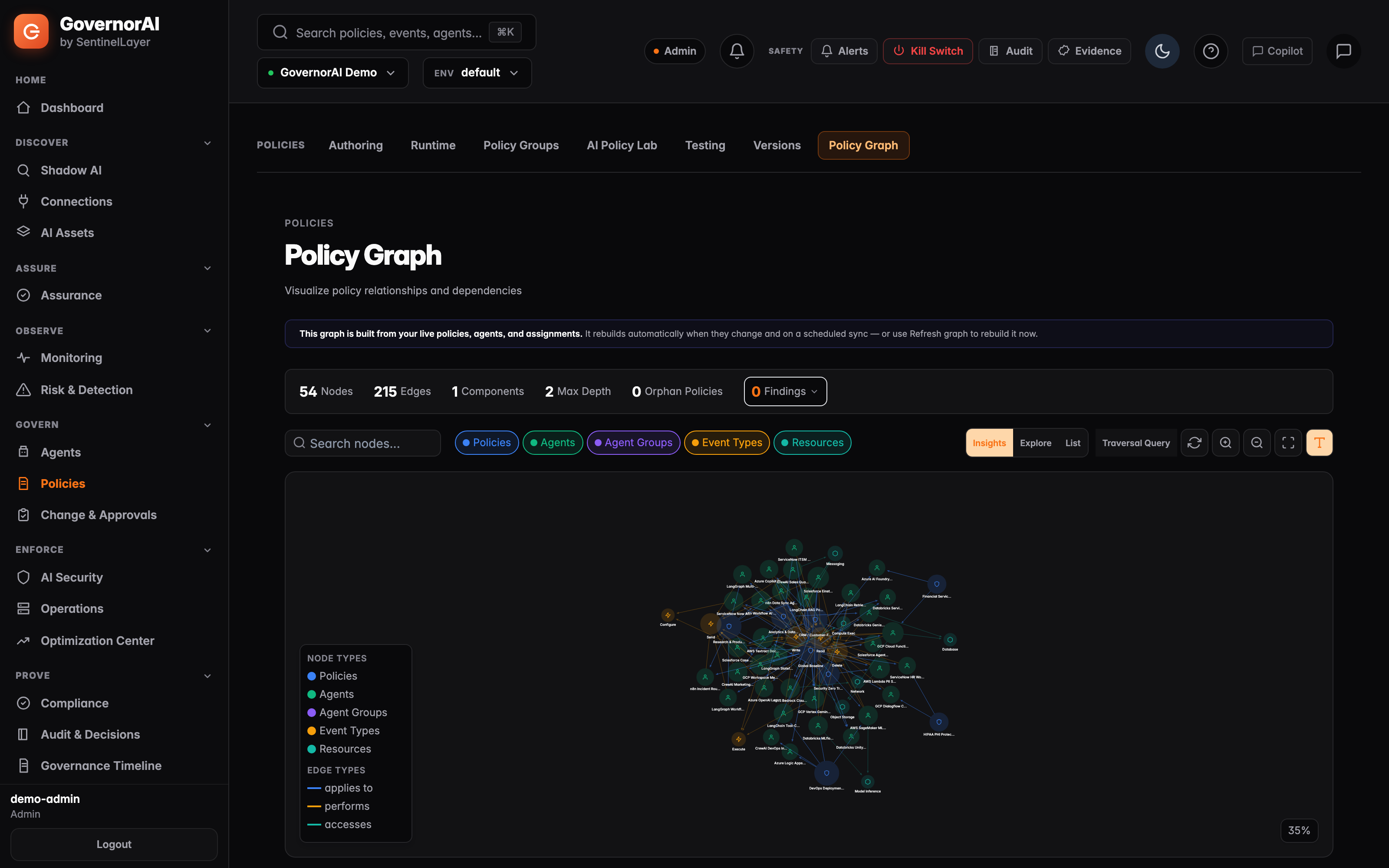
POLICY GRAPH · GOVERNANCE GRAPH
A policy in isolation tells you little. Two graphs answer the questions that come up in review: which agents, tools and seams does this rule reach — and for a given governed action, which policy decided it, under whose approval, against which control.
What a policy binds to, where two rules overlap, and which rules are never reached. The answer to "if I change this, what moves?"
A cross-domain map from a governed action back through the policy, the approval and the evidence to the control it satisfies.
Policy versions, approvals and rollouts on one timeline, so a reviewer can reconstruct the posture at the moment an action was decided.
POLICY AS CODE
Policy is a versioned artifact with a review process, not a setting in a console. It can be declared, planned and applied like the rest of your infrastructure.
# policy declared alongside the infrastructure it governs
resource "governor_policy" "refund_approval" {
  name            = "refund-approval-v4"
  governance_mode = "shadow"
  fail_closed     = true

  engine = "rego"
  source = file("${path.module}/policy/refunds.rego")
}Policies, assignments and governance modes are declarable. Changes go through the review your team already uses, and the resulting decision record is queryable rather than exportable-on-request.
IN THE PRODUCT